• Press
  • Offices
  • Contact
  • Legal notice
  • LinkedIn
  • EN
    • DE
  • UPC
  • Firm
    • Main Focus
    • History
    • Guiding Principle
    • Code of Conduct
    • Awards and Rankings
  • Our Team
  • News & Knowledge
    • News
    • Events
    • UPC-Update
    • IP-Update
    • EmpCo Directive
    • Publications
    • Subscription B&B Bulletin
  • Our Practice
    • Legal Areas
    • Industries
  • Career
  • Menu Menu
FIND EXPERTS
  • UPC
  • Firm
  • News & Knowledge
    • News
    • Events
    • UPC-Update
    • IP-Update
    • EmpCo Directive
    • Publications
    • B&B Bulletin
  • FIND EXPERTS
  • Contact
  • Offices
  • Our Practice
  • Career
  • EN
    • DE
  • Legal Areas
  • Industries

Sales of second-hand goods may constitute „genuine use“

8. February 2021/in IP-Update

In its decision in Cases C-720/18 and C-721/18 of October 22, 2020, the Court of Justice of the European Union (CJEU) further defined the requirements for “genuine use” of a trade mark. In addition to various important questions regarding the use of a trade mark, the court also commented on the burden of proof in cancellation proceedings due to non-use.

Background

The Regional Court and the Higher Regional Court of Düsseldorf had to decide on the revocation of the word/device trade marks TESTAROSSA registered for the Italian car manufacturer Ferrari. The Regional Court upheld the actions for cancellation on grounds of non- use, essentially stating that Ferrari has not sold any new cars under the trade marks  TESTAROSSA for 25 years. Ferrari only sells used cars and spare parts under the trade mark and provides maintenance services for such vehicles. The Higher Regional Court of Düsseldorf suspended the cancellation proceedings and referred various questions to the CJEU on the interpretation of the concept of “genuine use”.

Decision

First of all, the CJEU confirms that a trade mark registered in respect of a category of goods and replacement parts thereof must be regarded as having been put to „genuine use“, in connection with all the goods in that category and the replacement parts thereof, if it has been so used only in respect of some of those goods or only in respect of replacement parts or accessories of some of those goods. It should be otherwise only if it is apparent from the relevant facts and evidence that a consumer who wishes to purchase those goods will perceive them as an independent subcategory of the category of goods in respect of which the mark concerned was registered. The fact that the trade marks are used only for high-priced goods from the luxury segment is not an appropriate criterion for the formation of an independent subcategory.

Furthermore, the CJEU states a trade mark is capable of being put to genuine use by its proprietor when that proprietor resells second-hand goods put on the market under that mark. Thus, the exhaustion of the trade mark right by putting the goods on the market for the first time does not affect the question of “genuine use”.

Next, the CJEU confirms that a trade mark is put to genuine use by its proprietor where that proprietor provides certain services connected with the goods previously sold under that mark, on condition that those services are provided under that mark. The use of the mark for the services is a necessary condition to conclude that the mark has been put to „genuine use”.

Finally, the CJEU comments on the burden of proof in cancellation proceedings due to non-use. In this respect, the court confirms that the proprietor of a trade mark bears the burden of proof that the trade mark has been put to „genuine use”. Indeed, it is the proprietor of the mark at issue which is best placed to adduce evidence in support of the assertion that its mark has been put to genuine use. Member states may not deviate from this allocation of the burden of proof.

Conclusion

The decision is favourable for trade mark proprietors who have stopped selling new goods under their trade mark and limit their acts of use to the sale of second-hand goods and the provision of maintenance services. In the future, such acts can still be classified as “genuine use” of the trade mark. Accordingly, acts of use must be carefully documented, also with regard to resales and maintenance services, in order to be able to prove “genuine use” of the trade mark if necessary.

/wp-content/uploads/2022/04/boehmert_logo.svg 0 0 Petra Hettenkofer /wp-content/uploads/2022/04/boehmert_logo.svg Petra Hettenkofer2021-02-08 00:00:002022-08-02 12:01:13Sales of second-hand goods may constitute „genuine use“

“Over and out” – Brexit update on trade marks and designs after the end of the transition period

14. January 2021/in IP-Update, New Year's edition 2021 Designs, Trade Marks

The transition period expired December 31, 2020 and UK now finally left the EU. Even though the negotiating parties came to a free trade and cooperation agreement on December 24, 2020, the rules from the Withdrawal Agreement remain in place and will regulate the covered IP rights going forward. We provide a refresher and update as to what this means for trade marks and designs.

Even though the EU Commission and the UK government agreed on the outlines of a free trade and cooperation agreement on December 24, 2020 which has been confirmed by EU and UK, respectively, in the meantime, this does not change the fact that, as of January 1, 2021, EU rights such as, in particular, EU trade marks and Community designs have lost their effect in the UK. The same applies to their counterparts under WIPO administration, i.e. International Registrations under the Madrid Protocol and the Hague Agreement. We have already provided detailed information about this on other occasion.

Here now, very briefly, are the main and updated implications since January 1, 2021, as they follow from the Withdrawal Agreement.

Cloning of registered EU rights

Registered EU trade marks and Community designs will be copied – cloned – completely, fully automatically and free of charge into the national register of the United Kingdom. In this respect, nothing further is required. The same applies to collective marks and certification marks. In view of the large number of IP rights, the process will take some time. We will keep the owners of IP rights represented by us apprised of any development and details.

Right of refiling for pending applications

Until September 30, 2021, it will be possible to file a fee-based national application for a pending IP right as a trade mark or design, and in particular to claim the priority of the EU application. The effect of this is that no third party could have acquired an IP right with better priority in the UK since the EU application was filed. We will work out a suitable IP strategy with the owners of IP rights represented by us.

International registrations of trade marks and designs

If international registrations designate the EU, the process described above will generally apply the same way. The IP rights are cloned into the United Kingdom or establish a refiling right in the national register. In any case, this means that these rights will initially leave the international regime under the administration of WIPO and become purely national rights. We will work with the owners of IP rights represented by us to find solutions to any related problems.

Unregistered IP rights

Unregistered Community designs will continue as “Continuing Unregistered Designs” for their remaining term of protection. In addition, a “Supplementary Unregistered Design” will be established for first publications in the United Kingdom, which will only be valid there. Unregistered trade mark rights are generally not recognized under EU law. However, the United Kingdom, like some other national legal systems of the EU member states, offers a fallback option, the so-called “passing off”, which, however, regularly depends on use in the United Kingdom (“goodwill”).

Continued identification of a clone

IP rights derived from EU rights will remain permanently identifiable by their registration numbers. They will continue in the UK with the original registration numbers and add national prefixes.

Ongoing proceedings and contracts

Pending proceedings in the UK based on an EU right will continue with the clone. The reverse does not apply: National UK rights lose their protection against EU rights. Proceedings are concluded automatically.

Existing treaties concerning the EU may have to be interpreted as to whether they continue to apply to the UK. We advise on how to avoid pitfalls and how to share any financial burdens between the parties appropriately.

Genuine use and reputation

Use of an EU trade mark in the UK will no longer maintain an EU right as of January 1, 2021. If there is no genuine use in the EU, the EU trademark will be subject to cancellation at the end of 2025. The reputation of an EU trade mark in the UK will already be definitively disregarded in the EU as of January 1, 2021.

Renewal and representation in the register

National clones are subject to the same expiration dates as EU rights. They can be renewed, and in some cases must be renewed in the short term. This also applies to those EU rights for which the fees have already been paid before the expiration of protection, but the expiration of protection is not until 2021. The fees must be paid again for the clones. The moderate costs for renewal have already been fixed by the UK Office. We will inform the owners of the IP rights we represent about deadlines and payment dates.

We will continue to represent the clones in the UK Register. This also applies to refilings.

Opt-out and strategic advice

IPR owners are not obliged to make use of the above options. Cloned IP rights can be abandoned by simple declaration (“opt-out”) free of official fees. The deadline for filing a subsequent application can remain unused. However, it is useful not only to consider each individual case but to develop an overall strategy for the UK. This may include adjusting the filing strategy overall. We advise with the aim of optimizing the administration and costs for the owners of IP rights.

/wp-content/uploads/2022/04/boehmert_logo.svg 0 0 Petra Hettenkofer /wp-content/uploads/2022/04/boehmert_logo.svg Petra Hettenkofer2021-01-14 00:00:002022-08-24 13:53:12“Over and out” – Brexit update on trade marks and designs after the end of the transition period

The FCJ decides on identifying reports in the form of a search warrant on the occasion of the G20 summit in Hamburg

7. December 2020/in IP-Update

On 29 September 2020, the Federal Court of Justice (FCJ) ruled on the admissibility of identifying photojournalism on the occasion of the riots at the meeting of the group of twenty leading industrial and emerging countries at the beginning of July 2017 in Hamburg (G20 summit) (cf. FCJ, ruling of 29 September 2020 – VI ZR 449/19).

Facts of the case

The plaintiff, a private individual, brought an action for an injunction against a major tabloid on the basis of an identifying report. The background was the extensive reporting of the tabloid in connection with the G20 summit in Hamburg, during which there were also numerous demonstrations with considerable riots, which still occupy the criminal and civil courts today.

On 10 July 2017, the defendant published a report announced on its front page with the headline  “WANTED! Who knows these G20 criminals?”.
In the article it reads: “WITNESSES WANTED! Please contact the police

[…] What is going on in these serious criminals? They claim that they want to demonstrate against the G20 summit. Then they shoot steel bullets at police officers, which even penetrate the armour of a water cannon. They accept the death of people. […] Two helicopter pilots were blinded by laser pointers, one helicopter was fired at by a flare. The list of crimes committed by rioters in Hamburg is much longer. […]. Pictures from a police helicopter show how hooded guards hurl burning Molotov cocktails from house roofs at approaching officers. Other hooligans fired flares into the crowd, smashed windows, set cars on fire, built barricades, set fires right next to houses, looted shops or marched armed in groups through the city – all acts that can be punished as a serious breach of the peace (at least six months in prison). […] The Hamburg police are calling on people to upload pictures of the rioting on the website […] – or to contact the nearest police station. The investigators assure that all information will be treated anonymously. Only in urgent emergencies call the 110th [newspaper] supports the police, asks: Who knows the people in these pictures? They are strongly suspected of having committed serious crimes at the G20 summit”.

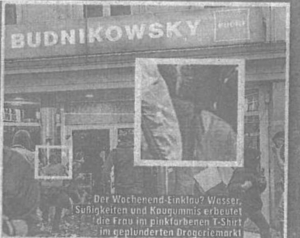
The verbatim report is accompanied by a total of thirteen pictures framing the text and showing various people in connection with the riots. The captions briefly describe and in some cases comment on the photographically documented behaviour (mainly throwing objects and stealing goods from shops). In some cases, details of the heads of these people are also shown enlarged. The following photographs of the plaintiff were taken in the context of this photojournalism, whereby the plaintiff in the large picture is the person photographed from behind, not wearing a mask, in a slightly stooped posture and with his head lowered, and in the small picture the person photographed from the front and diagonally above with his face covered about halfway.

(Source: https://juris.bundesgerichtshof.de/cgi-bin/rechtsprechung/document.py?Gericht=bgh&Art=en&sid=7a8fc385f67b93f4644342755d0e9cf9&nr=110997&pos=1&anz=9)

Preliminary proceedings initiated against the plaintiff were discontinued pursuant to § 153 (1) StPO, i.e. on the grounds of insignificance. The Regional Court of Frankfurt am Main, which was initially seized of the case, ordered the defendant to refrain from making the plaintiff recognisable in connection with the search for the G20 criminals by distributing her portrait. The Appeal Court of Frankfurt am Main dismissed the tabloid’s appeal, but allowed the appeal to the FCJ.

Grounds for the decision of the FCJ

The Federal Court of Justice decided – in contrast to the two lower courts – that the plaintiff has no claim against the tabloid under Section 1004 (1) sentence 2 by analogy, Section 823 (1) and (2) of the German Civil Code (BGB) in conjunction with Sections 22, 23 of the German Copyright Act (KUG), Art. 2 (1), Art. 1 (1) of the German Constitution (GG) to refrain from reproducing the image in the context of reporting. The FCJ based its decision on the following argumentation:

Portraits of a person may in principle only be disseminated with that person’s consent, which is not available in this case (Section 22 sentence 1 KUG). There are, however, exceptions to this principle under Section 23 (1) KUG, provided that the dissemination of the portrait does not violate the legitimate interests of the person depicted (Section 23 (2) KUG).

A portrait within the meaning of the KUG only exists if the person depicted is recognisable, about which there were some doubts due to the poor picture quality. However, the plaintiff in the present case could rightly rely on the fact that she could be recognised by her friends and acquaintances and in combination of both photographs on the basis of her body shape and posture, hairstyle and facial features.

As the next point, the Federal Court of Justice had to examine whether the photographs were portraits from the field of contemporary history (Section 23 (1) no. 1 KUG), for whose dissemination the consent of the plaintiff in favour of the defendant would have been dispensable. In the context of this examination point, a weighing had to be made between the rights of the plaintiff under Article 2 (1), Article 1 (1) of the Basic Law, Article 8 (1) of the ECHR on the one hand and the rights of the press, i.e. of the defendant, under Article 5 (1) of the Basic Law, Article 10 (1) of the ECHR on the other. The FCJ must therefore weigh up the general right of personality against the freedom of the press.

Within the framework of this weighing, the Federal Court of Justice initially confirmed that the interest in information is always the primary consideration for daily reporting on criminal offences or similar misconduct. According to the Federal Court of Justice, anyone who breaks legal peace and attacks or injures fellow human beings or the legal interests of the community through this act and its consequences must in principle tolerate the public interest in information, which he himself has aroused, being satisfied in the usual ways. The Federal Court of Justice then went on to point out, however, that the impairment of the right of personality must be in reasonable proportion to the seriousness of the misconduct and its other significance for the public, for which, of course, some doubts existed in the present case due to the discontinuation of the plaintiff’s criminal proceedings. However, according to the Federal Court of Justice, a lower public interest in information on minor misconduct in individual cases could be increased to such an extent by special features, for example in the person of the perpetrator, the type of misconduct or the course of the offence, that the interest of the perpetrator in protecting his or her personality would take second place. This is precisely what the Federal Court of Justice rightly assumed in the present case constellation:

The massive riots in public space on the occasion of the G20 summit in Hamburg and the circumstances surrounding them were “of very high social interest and subject of public discussion from various perspectives“. This concerned in particular “the aspects addressed by the defendant, which persons took part in them, how they behaved, what effects this had and that the police asked for the support of the public in clearing up the event“. Even the additionally enlarged head of the plaintiff does not change the factual content and the information value of the reporting, as it is only used as an editorial design and stylistic device.

On the plaintiff’s side, the FCJ assumed that the plaintiff could only be identified by a comparatively small circle of persons and that the plaintiff had been portrayed in public, i.e. in her social sphere. Even if the publication of the picture incriminates the plaintiff, it does not lead to stigmatisation, exclusion or pillory. Finally, the tabloid’s appeal is limited to supporting the police by providing clues, which means that the “call for information” is essentially an editorial stylistic device.

In conclusion, the Federal Court of Justice thus assumed that no legitimate interest of the plaintiff was infringed by the dissemination of the portrait.

Significant strengthening of freedom of the press

Despite the lurid headline “WANTED! Who knows these G20 criminals?” on the front page and the call for a search documented, among other things, by portraits of the plaintiff, the Federal Court of Justice decided that the plaintiff’s general right of personality must take second place to the basic right to freedom of the press. Decisive factors in this decision were the public interest that existed due to the massive riots and the fact that the plaintiff was only identifiable by a small circle and, in addition, had, as it were, voluntarily entered the media attention. The judgement must therefore be seen as strengthening the freedom of the press in the context of identifiable photojournalism.

/wp-content/uploads/2022/04/boehmert_logo.svg 0 0 Petra Hettenkofer /wp-content/uploads/2022/04/boehmert_logo.svg Petra Hettenkofer2020-12-07 00:00:002022-08-02 12:17:47The FCJ decides on identifying reports in the form of a search warrant on the occasion of the G20 summit in Hamburg

German Federal Supreme Court reorientation: Upgrading of weakly distinctive trademarks in case of likelihood of confusion

30. November 2020/in IP-Update

The decision of the German Federal Supreme Court (BGH) INJEKT/INJEX of February, 6 2020 is remarkable and fundamental for originally weakly distinctive prior trademarks or elements in trademark conflicts. Their importance in the assessment of the similarity of the signs has increased. In addition, the court also confirms the scope of genuine use extending in opposition proceedings to not too broad general terms covered by the registration.

In any case, – explicitly emphasized as new orientation and following the practice of the European Court of Justice (ECJ) – the BGH dogmatically underlines that weakly distinctive or descriptive trademark components cannot be excluded from the assessment of the similarity of the signs in the finding of a likelihood of confusion. If conflicting signs coincide only in descriptive elements, this fact cannot a priori be excluded for the examination of the respective overall impression of the conflicting signs.

Injection syringes INJEKT/INJEX – no likelihood of confusion according to the Federal Patent Court

In the trademark dispute between two pharmaceutical companies regarding specific injection syringes, pending since 2012, the German Federal Patent Court (BPatG) as prior instance had confirmed the rejection of the opposition of the previous instances regarding the earlier word marks INJEKT against the German word mark registration INJEX due to the lack of likelihood of confusion. Competitors could in principle approximate the term of their trademarks to the same descriptive indication. There would only be a far below-average aural or visual similarity between INJEKT and INJEX.

Referral back by the Federal Supreme Court – Taking into consideration of elements with a low degree of distinctiveness when comparing trademarks

First of all, the BGH – in accordance with the BPatG – assumes that the distinctiveness of the opposing marks INJEKT is originally below average due to the descriptive reference to medical syringes. The exchange of the letters “c” (“inject” being descriptive of “spritzen, injizieren” in German) with “k” leads to a – albeit low – per se distinctive character (“Eigenprägung”) and, thus registrability. This is increased to average distinctiveness through use.

However, the BGH upholds the appeal and criticizes that a likelihood of confusion cannot be denied precisely because the signs are not sufficiently similar. When examining the similarity of signs according to their respective overall impression, descriptive aspects of the signs must not be ignored from the outset and in general. Specifically and contrary to the BPatG, the assessment of the similarity of the signs must not only be based on the final consonants KT (for INJEKT) or X (for INJEX) – the elements which allegedly form the distinctive character (“eigenprägend”) of the conflicting marks. The visual and phonetic identity of the conflicting signs, apart from these final consonants, in form of the descriptive part alluding to the term “inject” should not be neglected in the overall perception of the marks.

Short comment

Up to now, there has been – at least on a dogmatic level – a divergence between the approach of the German and the EU courts in the assessment of likelihood of confusion in the face of weakly distinctive or descriptive marks (components). The BGH (e.g. in its decision GRUR 2012, 1040 – pjur/pure) already narrowly defined the scope of protection of such trademark registrations, namely limited to their distinctive part (“Eigenprägung”), i.e. to the distinctive element which was the basis for granting protection and, thus, beyond the descriptive content. As regards the similarity of the signs, descriptive indications – due to the consideration only of the distinctive and, consequently, dominant elements of the conflicting marks – were not taken into account in lack of a decisive influence on the overall impression of such mark. On the other hand, the EU courts (e.g. recently ECJ GRUR 2020, 52 – Hansson (Roslagspunsch/ROSLAGSÖL) did not a priori exclude similarities in weakly distinctive or descriptive elements from the assessment of the similarities of signs, in which the marks are generally to be compared as a whole. In order to avoid an overemphasizing of the element of the distinctiveness (as opposed to the weighting factor for the likeliness of confusion of the similarity of the signs), the aspect of weak distinctiveness is only considered in the overall assessment of likelihood of confusion.

The BGH has now explicitly moved away from the – dogmatic (by the a priori limitation of the scope of protection) – exclusion of descriptive components in the assessment of the similarity of signs. It has moved towards the ECJ’s line of a general comparison of the signs as a whole.

In practical terms, this may tend to enhance the value of identical weakly distinctive or descriptive elements, especially in the case of one-word marks. Similarity searches will certainly become more challenging with regard to “weak” trademark registrations.

Nevertheless, the fear of a straightforward favouring of weak marks in the assessment of likelihood of confusion and of an indirect monopolisation of descriptive indications is probably unfounded. Irrespective of both the BGH as well as the ECJ pointing out the possibility of applying for invalidation due to absolute grounds for refusal or, in infringement proceedings, to the free use exception due to descriptiveness, a likelihood of confusion will generally be denied in case of conflicting marks only coinciding in descriptive or weakly distinctive constituents as result of the overall weighting and the specific circumstances of the individual cases – already for lack of a determining influence on the overall impression of a trademark. Thus, the result of the assessment of likeliness of confusion will probably be mostly the same under the new “European” approach of the BGH compared to its previous systematic which a priori limited the scope of protection of marks eliminating their descriptive elements. The more open, broader consideration of the overall signs (including their descriptive elements) should be “captured”/”counterbalanced” by the lower importance of such components on the overall impression of the respective mark and during the overall weighing of the individual factors for determining the likeliness of confusion (in particular the low degree of distinctiveness). Nevertheless, weak marks should be taken “more seriously” and should be more carefully examined, even in a purely German context.

Clarification regarding genuine use

A further topic of the decision is not to be neglected: the BGH clarifies the scope of protection of a prior trademark challenged with the plea of non-use in opposition or infringement proceedings that the scope of protection of such trademark registered for a broad general term of goods/services is limited to the goods/services actually used. However, this means, that – beyond the specifically marketed individual product with all its individual characteristics (in this case credibility for “two-part disposable syringes”) – protection is also provided for similar goods (“gleichartige Waren”, here the product category “medical syringes”). The similarity is to be determined on the basis of an economic analysis. In the specific case, the BGH shares the result of the BPatG of an identity of goods between the extended product category “medical syringes” of the prior marks and the “needle free injection devices” claimed by the younger registration.

From a legal point of view, it is true that genuine use of the prior trademark in trademark infringement or opposition proceedings does not have a scope as broad as in trademark revocation proceedings. Due to the economic “moving space” to be preserved for the owner of the mark contested in revocation proceedings, genuine use for a specific/special product is to be considered genuine use also for a more comprehensive (not too broad) general term of goods in such proceedings. In trademark infringement proceedings, the use requirement generally requires the prior trademark being treated as if it had only been registered for the goods specifically used. However, this narrower perspective also includes – somewhat more broadly – similar goods.

/wp-content/uploads/2022/04/boehmert_logo.svg 0 0 Petra Hettenkofer /wp-content/uploads/2022/04/boehmert_logo.svg Petra Hettenkofer2020-11-30 00:00:002022-08-02 12:11:46German Federal Supreme Court reorientation: Upgrading of weakly distinctive trademarks in case of likelihood of confusion

The “Cyberbunker”, hosting providers and the e-commerce directive

18. November 2020/in IP-Update

Recently, on October 19, 2020, the criminal proceedings against the operators of the so-called “cyberbunker” started at the Regional Court of Trier (file no. 5 Js 30/15.2a KLs). The defendants are accused of operating a so-called “bulletproof hoster”, i.e. offering third parties web hosting services with the promise that the hosted content is anonymous and inaccessible to state authorities. Accordingly, the servers were allegedly used for all kinds of illegal activities, from drug trafficking to murder for hire. The defendants claim that they deliberately did not acquire any knowledge of the contents on the servers and did likewise not receive it. The public prosecutor’s office claims to have evidence to the contrary. This means that the operators could be deemed accomplices (by aiding and abetting) to the respective crimes.

What does this have to do with intellectual property?

Art. 14 E-Commerce Directive

At the European level, Art. 14 of the E-Commerce Directive (Directive 2000/31/EC) stipulates that the provider of a service that stores information provided by users is not “responsible” for this information if he has no “actual knowledge” of it (whereby grossly negligent ignorance may suffice with regard to claims for damages).

This provision is implemented in German law in the correspondingly drafted Sec. 10 of the German Telemedia Act. The prevailing view is that “responsible” refers to all areas of law, including criminal law. The German Federal Supreme Court (BGH) has further recognized that criminal law standards must be interpreted in conformity with EU directives (BGH, NJW 2014, 2595, para. 25).  Sec. 27 of the German Criminal Code, which regulates the criminal liability of aiding and abetting, must therefore be interpreted within the scope of the E-Commerce Directive in such a way that the so-called “double intent to assist” (intent with respect to the offence and intent with respect to aiding and abetting) can only be assumed in the case of “actual knowledge” within the meaning of Article 14, which does not necessarily mean the same as “dolus eventualis” of German legal doctrine, i.e. the so called approving acceptance which is usually sufficient to constitute intent to assist in the legal sense.

The case thus raises overarching questions, namely to what extent hosting providers must take note of their customers’ actions in a legal sense. Are you allowed to look the other way? Or not? And if so, how exactly?

These questions affect all hosting providers in a similar way, even though on closer inspection they may be answered (slightly) differently depending on the area of law.

Who acts in bad faith?

In the joined cases C-682/18 and C-683/18 pending before the ECJ concerning the copyright liability of the video service “YouTube” and the sharehoster “Uploaded”, the Advocate General, in his Opinion of 16 July 2020, makes some considerations on how the E-Commerce Directive relates to various copyright directives, but also makes it clear that the E-Commerce Directive can always apply even if an infringing act has already been constituted under another provision (Opinion, para. 138). Contradictions should be avoided by a consistent interpretation of such provisions on the one hand and Art. 14 of the E-Commerce Directive on the other (Opinion, para. 140).

However, “actual knowledge” means in principle actual knowledge in the literal sense (Opinion, para. 179).

Must such actual knowledge of the operators of the “cyberbunker” now be proven by the public prosecutor’s office regarding each individual act? If the ECJ follows the Advocate General, it may well be able to breathe a sigh of relief, since this could mean that “actual knowledge” could also be had by anyone who deliberately facilitates or invites unlawful uses (Opinion, para. 191), which might e.g. be the case with models of sharehosters who pay remuneration to those of their users whose files are downloaded particularly frequently (Opinion, footnote 186 in conjunction with para. 131).

However, it is not yet clear whether the criminal courts can assume such bad faith in the legal sense re the “cyberbunker”, because – according to the Advocate General – the promise of anonymity should not in itself lead to bad faith (Opinion, footnote 186 in connection with margin no. 129).

The operators’ defense attorneys have already announced that they will take this case up to the BGH. But perhaps the BGH will even (have to) call upon the ECJ. So come back to IP-Update in a few years if you want to know how the case resolved!

What is valid today may be outdated tomorrow – or even the day after tomorrow

The case thus refers to a – depending on the point of view – fundamental “problem”, namely that in harmonized EU law, certainty about legal issues can only arise through a judgment of the ECJ, but that it takes many years before a suitable case reaches this court and that its statements on the application of the law often only concern a limited section of a matter relevant to practice.

Will the criminal courts, for example, be able to refrain from a referral to the ECJ in the probably upcoming proceedings against the operators of the sharehoster “share-online” or will the requirements of the ECJ in the “uploaded” proceedings and its other case-law be sufficient for them? One will see, but doubt is in order.

The detailed questions that can arise in such cases are practically unforseeable. For example, the Regional Court of Hamburg recently had to decide in parallel proceedings against the sharehoster “uploaded” whether it would have an effect on its liability if it deletes links reported by right holders, which violate the law, but does not terminate the corresponding customer accounts at the same time, if these are excessively often conspicuous with violations of the law (Regional Court of Hamburg, judgement of 14 July 2020, Az. 310 O 339/18, para. 85 – quoted according to juris). The Regional Court was able to reject a corresponding submission to the ECJ with reference to the lack of a duty of referral for instance courts (para. 88). If an appeal is lodged, the BGH will in the end have to justify why the answer to this question is derived from the already existing ECJ case law. In doing so, it always risks that the German Federal Constitutional Court will see this differently and force it to make a referral.

In this context, it is possible that the fact that in the past there was no referral to the ECJ in questions of sharehoster liability just suspended the relevant questions. One might have thought, for example, that the ground for such liability had been laid out with the decisions “Alone in the Dark” (BGH, GRUR 2013, 370) and “Der Vorleser” (GRUR-RS 2013, 15390). Now, however, the decision of the ECJ in the “Uploaded” case will shatter old certainties.

Complete legal certainty (even if the DSM Directive is not taken into account) will therefore not be achieved in the foreseeable future, neither for rights holders nor platform operators, even though the E-Commerce Directive has now been in place for over 20 years. In the foreseeable future, it will probably be replaced by the Digital Services Act  – and then many questions that had once been answered might be open again.

/wp-content/uploads/2022/04/boehmert_logo.svg 0 0 Petra Hettenkofer /wp-content/uploads/2022/04/boehmert_logo.svg Petra Hettenkofer2020-11-18 00:00:002022-08-02 12:22:24The “Cyberbunker”, hosting providers and the e-commerce directive

“Congratulations, the patent is being granted.” Aspects to be considered in view of this good news.

11. November 2020/in IP-Update

As part of the EPO’s “Early-Certainty” initiative, European patent examiners are becoming increasingly proactive in the elaboration of the text for grant. There is a tendency for examiners to incorporate amendments into the application text themselves in order to provide the applicant with a text that is presumably ready for grant. While this examiner proactivity is in principle welcome, it should be treated with caution. Even amendments that are not made by the applicant should be critically examined and questioned. This applies not only to amendments to the claims, but also to amendments to the description.

Before a European patent is granted, the applicant must agree to the text intended for grant. The European Patent Office (EPO) may not decide to grant a patent without the applicant’s consent. If the EPO’s examining division has a favourable opinion on the subject-matter of the application, it will propose a text which it considers to be suitable for grant and which must be agreed by the applicant in order for a patent to be granted.

The Examining Division’s proposal often contains amendments to the text of the application as last filed by the applicant. As part of the EPO’s early-certainty initiative, patent examiners are becoming increasingly proactive in the grant procedure. Where examiners consider that the patent application still needs to be adapted in order for being fully acceptable for grant, they are increasingly prone to incorporate amendments into the description and even the claims. Such amendments are introduced into the text proposed for grant by the examiners themselves. These amendments are indicated in the so-called Druckexemplar which applicants receive as an annex to the Communication of intention to grant under Rule 71(3) EPC.

This pro-activity of patent examiners in promoting the granting procedure will generally be welcomed by most applicants. By introducing amendments themselves, examiners can present to the applicant an application text that is in principle suitable for grant, thereby avoiding further iterations between the Office and the applicant or even oral proceedings. The applicant can then have the application granted on the basis of the proposed text simply by agreeing to it.

It should be noted, however, that the EPO accepts no liability for amendments proposed or introduced in the application by patent examiners. If the applicant agrees to the amendments proposed by the patent examiner, they are deemed to have been made by the applicant himself. Any legal disadvantages resulting from such amendments are therefore solely attributable to the applicant. Therefore, the Druckexemplar must always be examined carefully. Applicants are well advised to always have any discrepancies in the Druckexemplar over the lastly filed text of the patent application examined by a patent attorney and to question them if necessary. Of course, this applies in particular – but not only – to amendments of the claims. Amendments to the description can also be critical and should not be systematically underestimated.

Amendments made by the examiners themselves often concern formal amendments to the description, for example to delete superfluous or inadmissible text passages which have no connection with the invention.

However, there is a growing tendency among examiners to amend the description also to acknowledge the prior art cited in the examination procedure in the description (as required by Rule 42(1)(b) EPC) and to adapt the content of the description to the subject-matter of the claims to be granted (as required by Rule 42(1)(c) EPC). For example, if features of a dependent claim are included in an independent claim, the Office will normally require that such features are not indicated in the description as mere optional or preferable features, but as features of the invention in its broadest sense. If the description discloses embodiments which are no longer in line with the claims due to claim limitations, the Office demands that either the corresponding description passages are deleted or that it is explicitly stated that they do not represent embodiments of the invention but only explanatory “examples” (see decision T 1808/06, R. 2).

These “adaptations” of the description, which are sometimes carried out by patent examiners and which might at first sight not appear to be harmful, may in certain circumstances prove to be detrimental to the applicant, particularly as they may affect the scope of protection defined by the patent.This risk must be assessed in the light of the relevant case law, both at European and national level.

Acknowledging state of the art in the description

The inclusion in the description of information on the relevant prior art documents cited in the course of the examination procedure should not be done too lightly. Even these indications, which might be considered irrelevant by many, should be checked by a patent attorney when they are introduced into the application text at the examiner’s initiative:

In decision T 2450/17, the EPO Technical Board of Appeal confirmed the Opposition Division’s view that an amendment to the description made during the grant procedure for the purpose of citing a prior art document may constitute added subject-matter contrary to Article 123(2) EPC, if the added information has a broadening effect with respect to claim interpretation and with respect to the subject-matter of the application. Citations of the prior art are thus capable of giving rise to added subject-matter issues which, in worst case scenarios, might lead to the revocation of the patent after grant.

In the decision X ZR 16/17 of 27 November 2018 – Scheinwerferbelüftungssystem, the German Federal Supreme Court ruled that the assessment of a document of the state of the art in the description can be decisive for the interpretation of the claim. If an independent claim is formulated in the so-called two-part form (i.e. divided into a preamble and a characterising part by “characterised in that”) and if the disclosure of a document of the state of the art is equated in the description with the preamble of the claim, the features of the characterising part should, in case of doubt, not be interpreted as being disclosed in that document. In cases in which the interpretation of terms may be decisive in determining whether the claimed subject-matter is anticipated by a prior art document, it may thus be advantageous for the applicant to draft the claim in the two-part form specifically with regard to that very document and to make express reference to it in the description. This is an interesting possibility for applicants to remove any conceptual ambiguity in their favour.

A discussion about the state of the art in the description can thus have a positive or negative effect on the scope of protection of the patent to be granted. Where such information is included in the text of the application at the initiative of a patent examiner, it should be carefully examined to ensure that it does not prejudice the interests of the applicant. 

Adaptating the description to the subject-matter of the claims to be granted

Likewise an adaptation of the description aimed at indicating certain embodiments as not belonging to the claimed invention may be excessively prejudicial to the scope of protection conferred by the patent. Where such amendments are made by the examiner, it will always be necessary to check that they do not classify more than strictly necessary as “not belonging to the invention”.

In addition, care should be taken to ensure that no embodiments remain in the description which are to be regarded as invading the equivalence scope of the claims. According to the current case-law of the German Federal Court of Justice on equivalent infringement, embodiments which are disclosed in the description but are not covered by the claims are excluded from the equivalence scope of the claims for legal reasons. In such cases, the case law generally assumes that the applicant has made a deliberate selection decision against the non-claimed variants (BGH decision X ZR 76/14 of 26.08.2016 – V-förmige Führungsanordnung, marginal no. 27), for which such variants are deemed as not protected.

In the text of a patent application to be granted, care should therefore be taken to ensure that the description does not provide a basis for asuming such a „selection“, if this is not actually meant. To avoid such an assumption, care should be taken in particular to ensure that the patent description does not mention any embodiments which are not claimed. It remains unclear to date whether relabelling an invention variant originally described as an “embodiment” as an “explanatory example” upon request of the Examining Division precludes the adoption of a selection among several embodiments in the sense of German case law on equivalent infringement, even though this seemed to be hinted at in the Pemetrexed decision (cf. BGH decision X ZR 29/15 of 14 June 2016 – Pemetrexed, marginal no. 68).

In such cases, it may therefore be worth considering as a matter of precaution whether embodiments which are potential equivalent forms of infringement should rather be deleted from the application text so that they are not mentioned in the patent specification and can thus remain within the scope of equivalence of the patent to be granted. This is likely to apply in particular in situations in which the embodiments to be indicated in the description as not covered by the claims at the request of the examiner would be possibly patentable by themselves (see BGH decision X ZR 29/15 of 14 June 2016 – Pemetrexed, marginal no. 67). Alternatively, an explicit reference in the description that the excluded invention variants are merely excluded from the literal scope of protection may be advisable  (e.g. “Figure 1 shows an example (where previously “an embodiment.” was written) that does not belong to the invention as literally defined in the claims”).

If the description is adapted by the examiner to the subject-matter of the claims, the amendments should always be carefully examined to check whether they classify as mere explanatory examples embodiments which are possible equivalent infringement forms as mere examples. In these cases it may be advantageous for the applicant to delete these embodiments completely in view of the applicable case law, in particular with respect to their interests in Germany. This is a further reason why even such seemingly harmless adaptations of the description should be subject to a thorough examination by a patent attorney.

TAKE AWAYs:

– Amendments made to the text intended for grant on the Examining Division’s initiative should always be carefully examined by a patent attorney and, if necessary, questioned.

– Amendments to the description can also influence the scope of protection. They should therefore not be systematically considered as irrelevant.

– When acknowledging state of the art documents in the description, evaluative statements which may affect the interpretation of the claim should be avoided.

– It should be decided on a case-by-case basis whether the two-part claim is appropriate. In the case of critical documents of the state of the art, a two-part version of the claim may be advantageous.

– When adapting the description to the subject-matter of the claims, attention should be paid to the consequences for the scope of protection of the patent of indicating an embodiment as “not belonging to the claimed invention “. This analysis should also take into account the possible equivalence scope of the claims.
/wp-content/uploads/2022/04/boehmert_logo.svg 0 0 Petra Hettenkofer /wp-content/uploads/2022/04/boehmert_logo.svg Petra Hettenkofer2020-11-11 00:00:002022-08-02 14:11:40“Congratulations, the patent is being granted.” Aspects to be considered in view of this good news.

The ECJ decides in the matter of “YouTube third party information”

14. October 2020/in IP-Update

Legal starting position

With the Enforcement Directive (Directive 2004/48/EC), the European legislator instructed the member states to provide right holders in intellectual property matters with the possibility of enforcing rights to information in court, if necessary, not only directly against the infringers of property rights, but also against platforms that were used to infringe IP.

Specifically, Art. 8 para. 1 c) and para. 2 a) of the Enforcement Directive stipulates that information on the “name” and “address” of the infringer may be requested from persons who demonstrably provide services on a commercial scale used for infringing activities. The German legislator has implemented this requirement in the various laws on intellectual property (e.g. Section 101 (2) sentence 1 no. 2 German Copyright Act, Section 140b (3) no. 1 German Patent Act, Section 19 (3) no. 1 German Trademark Act, etc.). ).

A typical example of a service in the sense just mentioned is the provision of an Internet platform which end users can use for various purposes, in particular to post their own content on the platform, in particular the video platform “YouTube”.

Often, however, the provider of the platform is not aware of the “name” in the sense of the civil name and the “address” in the sense of the postal address of a user who infringes intellectual property. At best, the posting of content on the platform is only possible via a user account created on the platform, for the creation of which data such as an e-mail address may be provided.

It is therefore questionable whether “name” and “address” within the meaning of Art. 8 (2) a) of the Enforcement Directive and the German transposition laws can also be other data than the civil name and the postal address.

Submission of the BGH

The German Federal Supreme Court (BGH) had to deal with this in the case “YouTube third party information” (order dated February 21, 2019, case no. I ZR 153/17, available at bundesgerichtshof.de). Specifically, the issue was whether the owner of rights to a film work that had been illegally uploaded by a user to his YouTube account can demand that the platform provide him with the user’s e-mail address, telephone number and dynamic IP address (once at the time of upload and once the last known). The BGH discusses various arguments for and against this and refers in particular to the possibility that there could be a claim for further information, in particular the civil name and the postal address, against the providers of the e-mail address and the telephone number.

However, it finally acknowledges that the answer to this question ultimately depends on the interpretation of Article 8(2)(a) of the Enforcement Directive and therefore submits it to the ECJ.

Decision of the ECJ

In its decision, the ECJ (judgement of 7 July 2020, Case C-264/19, ECLI:EU:C:2020:542, available at curia.europa.eu) also weighs up various arguments, but finally comes to the conclusion that “name” and “address” are in fact to be understood only as civil name and postal address. At the same time, however, and with reference to the merely minimum harmonising character of the Enforcement Directive and its Art. 8 para. 3 a), it leaves it up to the member states to grant rights holders further rights to information, as long as the various relevant fundamental rights and the principle of proportionality are sufficiently taken into account.

How will the BGH decide?

From a purely legal-doctrinal point of view, there are good arguments for and against the extension of the information rights envisaged by the BGH. For a forecast of how the BGH will actually decide, it is therefore worth taking a look into the past: in an earlier decision, the BGH had already interpreted “name” and “address” broadly and subsequently also included the so-called user ID, which is relevant for the provision of information by Internet access providers in reseller constellations (decision of July 13, 2017, Case No. I ZR 193/16).

However, a differentiation is also conceivable to the effect that dynamic IP addresses are excluded from the right to information, especially in view of the recent “Bestandsdaten II” decision of the Federal Constitutional Court, in which the latter once again emphasized the special sensitivity of dynamic IP addresses to fundamental rights (decision of 27 May 2020, case no. 1 BvR 1873/13 and 1 BvR 2618/13, available at bundesverfassungsgericht.de).

The decision of the Federal Court of Justice will also be followed by the question as to what the rights holder can do with the information, i.e. in particular whether it can subsequently request further information from the providers of the e-mail address and the telephone number as well as from the Internet access provider. Here, too, numerous legal questions remain open.

Conclusion

It is difficult to gatherpersonal data of an infringer on the Internet. At the same time, his civil name and postal address are required for the judicial enforcement of rights. Which service providers have to provide which information is still unclear in many aspects. The decision of the BGH will probably clarify at least some of these.

/wp-content/uploads/2022/04/boehmert_logo.svg 0 0 Petra Hettenkofer /wp-content/uploads/2022/04/boehmert_logo.svg Petra Hettenkofer2020-10-14 00:00:002022-08-02 14:15:46The ECJ decides in the matter of “YouTube third party information”

LAG Düsseldorf – Requirements for contractual regulations as an appropriate measure for the protection of trade secrets

5. October 2020/in IP-Update

The German Act on the Protection of Trade Secrets (GeschGehG), which came into force on April 1, 2019, has still only been the subject of court decisions to a very limited extent. Accordingly, there is still a great deal of uncertainty as to how the constituent elements of the law will ultimately be interpreted by the courts and what consequences this will have in practice.

The Düsseldorf Regional Labor Court (ruling of June 3, 2020 – 12 SaGa 4/20, available here) has now issued a decision on whether and under what conditions contractual regulations can be appropriate measures for the protection of trade secrets within the meaning of § 1 b) GeschGehG.

Contractual provisions alone can also constitute adequate protection measures – if they are sufficiently concrete

The court initially stated that in principle contractual provisions alone can also be regarded as adequate protection measures for trade secrets within the meaning of Section 1 b) GeschGehG. However, a precondition is that the relevant trade secrets and documents covered by the contractual provision are described more precisely.

Only general contractual provisions according to which all information and documents exchanged in the course of the cooperation between the parties shall be subject to the obligation of secrecy do not, in the opinion of the court, meet the requirements of an appropriate protective measure within the meaning of Section 1 b) GeschGehG.

In the opinion of the court, a further prerequisite is that a certain activity with regard to the protection of secrecy must result from the implementation of the existing contractual provisions. Unfortunately, what exactly the court understands by this remains unclear, but it could well be understood in the sense of a requirement for active control measures of the owner of the trade secret with regard to compliance with the contractual regulations.

Assessment of the circumstances of the individual case required

The court also points out that the question of when measures to protect business secrets are appropriate must be answered according to the specific circumstances of the individual case in the sense of a proportionality test. The court lists the following criteria as possible criteria for this purpose: value of the trade secret and its development costs; nature of the information, significance for the company; size of the company; the usual confidentiality measures in the company, the way the information is marked, contractual arrangements agreed upon with employees and business partners.

Recommendations

The decision and in particular the relatively extensive statements of the court show that there is still considerable uncertainty in answering the question which measures have to be taken in order to provide adequate protection for trade secrets within the meaning of Sec. 1 b) GeschGehG. In particular, if confidentiality agreements have not yet been revised after the GeschGehG came into force, the court’s comments on the problem of a definition of the subject of protection being too broad and vague should be taken into account. Here, care should be taken to ensure that the relevant clauses are made correspondingly concrete – for example, by means of dynamic references. In addition, it is recommended that the relevant documents and information in which the trade secrets to be protected are embodied be clearly marked accordingly.

In addition, contractual provisions for the protection of trade secrets should always be only one component of a more comprehensive secrecy protection concept, which also includes technical and organizational protection measures as well as a categorization of trade secrets and their level of protection.

/wp-content/uploads/2022/04/boehmert_logo.svg 0 0 Petra Hettenkofer /wp-content/uploads/2022/04/boehmert_logo.svg Petra Hettenkofer2020-10-05 00:00:002022-08-02 10:20:12LAG Düsseldorf – Requirements for contractual regulations as an appropriate measure for the protection of trade secrets

Federal Supreme Court on entitlement to remuneration in the case of only a majority decision on the permission of use in a community of inventors – consequences for the drafting of contracts

28. September 2020/in IP-Update

Inventions are often not made by one inventor alone, but by several inventors who then form an inventor’s community. As far as there are no deviating contractual regulations, the legal relationships of the members of the community of inventors are based on the regulations concerning the community of fractions according to §§ 741ff. of the German Civil Code. The German Federal Supreme Court (FSC) has now decided on the question of the entitlement to remuneration in a case in which a third party was only permitted to use the joint invention by a majority decision of the community of inventors (decision of June 9, 2020, X ZR 142/18 – Penetrometer).

Right of disposal of each co-inventor over his share of the invention

In the decision, the Federal Court of Justice first of all clarifies once again that, in the absence of deviating agreements, each co-inventor may in principle dispose of his share of the invention and is also entitled to allow third parties to use the invention as long as a majority decision is reached within the community of inventors in accordance with the shares in the joint invention.

Majority resolution does not remove the entitlement of the non-approving members of the community of inventors to claim

The special feature of the case decided by the Federal Court of Justice, however, was that the permission of use only provided for payment of the fee to the co-inventor who had agreed to the granting of rights by majority resolution, but not to the community of inventors as such. The other members of the Inventors’ Association therefore had no direct claim for payment against the third party from the use granted by the co-inventor. In this respect, the Federal Court of Justice came to the conclusion that the interests of the other members of the community of inventors with regard to the drawing of the fruits from the joint invention were unlawfully impaired, notwithstanding the majority resolution at hand. The arrangement made between the co-inventor and the third party should have provided that the fees to be paid were not to be paid to a co-inventor alone, but to the community of inventors as such, so that all members of the community of inventors had equal access to them. The mere fact that the other members of the community of inventors would have a claim for compensation against the co-inventor in the internal relationship would not be sufficient to eliminate the impairment.

Consequences for contracts

The decision of the FSC makes it clear that great attention is still required for legal regulations which deal with the granting of rights to joint inventions. This is especially true if not all members of the community of inventors agree to the granting of rights, but only by majority vote. Although the granting of rights by majority vote is possible under the rules of the fractional community, the Federal Supreme Court emphasized that in this case all members of the community of inventors must be equally entitled to claim the fruits of their efforts in the form of compensation. From a contractual point of view, this means that the creditor side of the payment claim must be defined accordingly and that appropriate arrangements for payment processing must also be made. For example, a payment made only to an account to which only one co-inventor has access is unlikely to meet these requirements.

/wp-content/uploads/2022/04/boehmert_logo.svg 0 0 Petra Hettenkofer /wp-content/uploads/2022/04/boehmert_logo.svg Petra Hettenkofer2020-09-28 00:00:002022-08-02 14:21:48Federal Supreme Court on entitlement to remuneration in the case of only a majority decision on the permission of use in a community of inventors – consequences for the drafting of contracts

Facebook reads German – who else?

20. August 2020/in IP-Update

According to the Appeal Court Munich (ZUM-RD 2020, 364), it is possible to serve court documents onto Facebook in Ireland in German language. Can a general rule be derived from this decision which is based on the language skills present at Facebook in Ireland? This article tries to shed some light.

1. Starting point of the Appeal Court Munich

The decision centers around the question whether a preliminary injunction that issued in Germany, may be served onto Facebook in German, or Facebook could require a foreign language translation (English). According to the Senate, it was necessary to confirm that the language of the court decision is a language that the addressee understands. In case of legal persons, not only the skills of officers and authorized personnel were relevant, the Senate holds, but any available skills within the company that the management level can reasonably make use of.

That way, the Appeal Court Munich significantly extends options to serve court papers and documents in German language onto international players, specifically in the social media business.

In casu, the Appeal Court Munich relied on Facebook’s offering of the service in Germany in German, including all contractual provisions, terms and conditions, which, partly, made German laws binding and accepted venue in Germany (in consumer matters). Facebook was not successful to argue that no one in the legal department in Ireland read German in a way to handle (court) documents properly without external advice and consult, or to defend the company comprehensively in German.

While the Court shared the position that the addressee must be able to fully comprehend the relevance and scope of the claims raised abroad in order to make possible a sound defense, it is also stressed that a proper balancing of interests between the parties was required. A company the size of Facebook’s was, according to the Court, presumed to have personnel to comprehensively handle legal dispute in German language. When a company undertakes to fulfill a contract in a specific language, there was a rebuttable presumption that service of (court) documents can also take place in that language.

2. Case groups of document service abroad in German

The Munich decision shows that there is no definite answer to the question, when a translation is required and for which type of foreign company. The balancing of interests is a case-by-case analysis and the claimant arguing that no translation was required has to adduce proper evidence to this end.

The two conclusions drawn by the Appeal Court Munich go beyond what has been discussed in and accepted in previous cases. The Appeal Court Frankfurt/Main found back in 2015 (GRUR-RR 21015, 183) that not only legally trained personnel adept of the language in question must be present but also that their involvement in the specific matter was to be expected a natural step, when, e.g., they had been involved in this matter beforehand, including out of court.

Moreover, it was reasonable to conclude that such documents reached the managing level or the legal department. If there are appropriate language skills within these organizational groups, no translation of the German document was required.

According to the fresh decision handed down by the Appeal Court Munich, the latter is no longer a requirement. In fact, the addressee is obliged to make use of other internal sources. This prevents random or erratic results but stretches the limits of what language a company has to accept well beyond past limits.

Even though, as a general rule and for good reason, the Federal Supreme Court is reluctant to accept presumptions and prima-facie evidence regarding foreign language skills, the Munich decision offers some solid fact-based conclusion, and is seems reasonable to say that international addressees must not act inconsistently with previous or related conduct and business.  Finally, this result gives full effect to the purpose of the applicable statutory provisions, at least of those valid in the EU, namely, to reduce the need for translations to the extent possible.

/wp-content/uploads/2022/04/boehmert_logo.svg 0 0 Petra Hettenkofer /wp-content/uploads/2022/04/boehmert_logo.svg Petra Hettenkofer2020-08-20 00:00:002026-05-12 14:38:09Facebook reads German – who else?
Page 6 of 7«‹4567›

Latest posts

  • Scales of justice representing the Unified Patent Court (UPC) and current developments in European patent litigation
    Court of Appeal extends jurisdiction of the Central Division for infringement actions29. July 2026 - 13:43
  • Hamburg waterfront at sunset with the Elbphilharmonie
    Meet us at The Port of Hamburg by Night on October 8, 2026!28. July 2026 - 9:30
  • Portraits of Minsun Song and Dr. Fabian Schmidt to announce that they have passed the EQE exam.
    Minsun Song and Dr. Fabian Schmidt pass the European Qualifying Examination23. July 2026 - 10:56

Categories

Archive

Menu

  • Firm
  • Our Practice
  • Career
  • News & Knowledge
  • LinkedIn
  • FIND EXPERTS

Informations

  • Press
  • Contact
  • Legal notice
  • Data Protection
  • General Terms and Conditions
  • Subscription B&B Bulletin
  • Contact

Legal Areas

  • Employee Inventions
  • Data Protection
  • Designs
  • Domains
  • Information Technology
  • Anti-Trust
  • Licensing
  • Trade Marks
  • Patent Valuation
  • Patents & Utility Models
  • Patent Litigation
  • Product Piracy
  • Copyright
  • Unfair Competition

© Copyright 2026– BOEHMERT & BOEHMERT

Scroll to top Scroll to top Scroll to top